News
News #6 (November 10, 2026)
Talofa from American Samoa! Our adventure is slowly coming to an end. We will go QRT at local sunrise on November 12. Overall, we are satisfied with the results, though we had hoped for more—especially when it comes to Europe, which is more than 16,000 km away.
Conditions via the North Pole to Europe were not good. Even top stations from Central Europe rarely came in stronger than S3. Up to 10,000 km (U.S., Japan, China, South America) away from the polar region, signal levels were better, but still not always strong. The low bands were a disappointment, especially the 160-meter top band. The noise level was extremely high. Conditions on 60 m and 80 m were also peculiar. Sometimes the bands were full of stations; other times, hardly any station could be heard or read. Even the BOG, used as a receiving antenna, provided only minor improvements. The hardware used worked flawlessly: the K4 transceivers, together with the small Juma power amplifiers, allowed for comfortable operation.
FT8 is both a blessing and a curse. When signals are barely identifiable in CW, they are still receivable in FT8. However, the decline in activity on the traditional bands is clearly noticeable. We started out on the FT8 expedition frequencies. Here, the QSO rates are significantly higher due to multistream operation. Often, though, interest waned after just a few callers. Then we gradually shifted our operations to the standard frequencies. This had a negative effect on the QSO rates. Many DXpeditions are familiar with this effect. The proportion of FT8 QSOs is just over 50 %. The remaining portion roughly equally among CW, SSB, and RTTY. Fortunately, there were still a few short, good high-band openings to Central Europe in the last few days. This brought the European share to around 22%.
By the end of the DXpedition, there will be a good 60,000 contacts in the log. We are confident that we’ve helped many hams earn a new DXCC, a new slot, or a new band point. After our return to Germany, we’ll review any log claims and upload a corrected log to Club Log. We plan to begin mailing paper QSLs and sending out the first LoTW confirmations to our supporters before the end of this year.
Unfortunately, dupes (more than one QSO on the same band and mode) were also a challenge on this DXpedition. We would like to once again urge the DX community to check the online log or the livestream before calling again. Our online log on Club log is updated at least once a day. The livestream displays the stations we have worked in near real time.
We operated in shifts of three operators each, with the respective operators selecting the bands and modes. Team spirit and morale remained consistently high throughout.
Tuituila, the main island of American Samoa, is a beautiful island with wild nature and friendly people. The tropical climate was quite bearable for us Central Europeans. Compared to other islands that are significantly closer to the equator, temperatures in Pago Pago are lower. It also cools down considerably at night. The car is the primary means of transportation, with a speed limit of usually 25 miles per hour. Drivers are very considerate. Many buses are colorfully decorated. Infrastructure and supermarkets were plentiful. Prices are somewhat more affordable than in Hawaii.
The QTH was well-suited as lodging for a larger group. However, the property was a bit too small for five antenna masts and multi-station operation. Behind the house, the two low-band antennas — 160/80 m and 40 m — were flanked by several overhead power lines. The 115 V power supply at our QTH did not experience any outages. However, the voltage sometimes dropped below 100 V, causing some power amplifiers to shut down occasionally.
Our thanks go out to everyone who supported us and worked with us. Good DX.
News #5 (November 6, 2026)
KH8A has now been on the air for half of the planned time. It’s time to take stock. Conditions, particularly toward Central Europe, have so far fallen well short of our expectations. Our hope for strong EU openings – where even OMs with 100 watts and wire antennas would have a chance – has not yet materialized. On no band have we received truly strong signals from the EU so far. The same is true in the opposite direction. DX signals coming over the polar caps often only reach S3. A distance of 15,000+ km poses a real challenge. Picking out the many faint callers is no easy task, even on CW, partly due to the fairly high noise floor. The fact that we’ve now gathered insights into the openings on the various bands is only of limited help in this regard.
We receive many emails with suggestions and requests. Rest assured that we are working every day to improve the radio conditions. However, not everything we’d like to do can be implemented.
The noise level on the low bands is very high, reaching nearly S9 on 80 m and 160 m. Initially, we used a horizontal loop antenna on the ground as our receiver antenna, which improved the receiver signal-to-noise ratio by up to two S-units. The downside, however, was the expected significant attenuation of the useful signals. Therefore, we are currently operating a 65-meter-long Beverage on Ground (BOG), which improves the situation, particularly on 80 m and 60 m. 160 m, on the other hand, is a disappointment. Despite an 18-meter mast and two elevated radials, the PSK Reporter reports that our signal barely reaches beyond 8,000 km. Regardless of the challenging conditions on the low bands, we will continue to be active on these bands during greyline hours. We are aware that demand remains high even on 30 m and 40 m in CW. However, even here the signals are only slightly above the noise floor.
On the high bands, things look a bit better thanks to the recent increase in solar flux. But even here, signals from Europe and the U.S. are weak. Japan and the U.S. West Coast, which are practically “right on our doorstep” in the Pacific, are over 7,500 km away. The 6 m band, on the other hand, is a flop. On the Magic Band, we haven’t heard or seen a single signal so far. That’s why we’ve reduced our operating time on this band.
Due to the relatively close proximity of the five antennas – a result of the layout of the property – there is occasional interference with certain band configurations among the up to five stations. To minimize this, we have set up an additional 12-meter rhombic loop to take advantage of band openings with as little interference as possible.
The team’s morale remains high despite the challenging conditions. Thanks to the well-equipped kitchen, cooking for ourselves works out perfectly. A few restaurants offer some variety in our meals, though their hours don’t always align with our shift schedules. It’s nice that, despite the island’s remote location, groceries are more affordable than in Hawaii. Last but not least, there’s time for some sightseeing between shifts: the rugged coastal landscape is truly impressive. We’ve already been able to take many beautiful photos.
News #4 (November 2, 2026)
On October 29, our group of nine arrived by plane in Pago Pago after dark and was busy setting up the stations well past midnight. The QTH is a spacious house with a large living room and surrounding property, providing room for several antennas. The same house was used by the KH8T team in 2024 and is a good choice overall. The availability of good QTHs is limited, in part due to the island’s topography. We would like to take this opportunity to once again thank the KH8T team for the wealth of valuable information they provided in advance.
The house has four bedrooms with eight double beds, two bathrooms, and air conditioning on the ground floor. The kitchen is well equipped and designed for self-catering. A supermarket is located just 100 meters away. The weather is tropical and humid: mostly sunny with temperatures ranging from 27 to 30 degrees Celsius, and occasional heavy rain showers.
Operating multiple stations with power amplifiers on the 115-volt mains supply is challenging. Electricity must be paid for in advance. Prices in American Samoa have risen by about 50 percent since February 2026. The main driver is diesel. Diesel generators primarily generate electricity on the island.
The fiber-optic internet connection is stable, allowing us to offer a livestream on Club Log. https://clublog.org/livestream/KH8A There everyone can see within a few seconds whether his QSO has been logged or not. The KH8A log can also be found on Club Log and will be updated daily. We hope this will help reduce the number of duplicate QSOs.
All planned antennas have now been set up. The morning after our arrival, we erected the wire beam for 20 m to 10 m and the antennas for 30 m, 40 m, and 6 m. The first QSO took place at noon on October 30 (23:10 UTC) with WD0DAN in CW on 15 m.
We have now been QRV for more than 48 hours, and the log shows over 21,000 QSOs from 118 DXCCs. The noise level is acceptable. In addition to FT8, we are making a balanced effort to cover also CW, SSB, and RTTY well. However, the overall DX signal levels remain challenging. The radio conditions—with an SFI of 92, A > 20, and K 3 to 4—still leave room for improvement. The 10-meter band, in particular, has been of little use for DX traffic so far. As expected, Japanese stations—located “only” 7,500 km away—dominate all bands. Europe has only been audible in brief windows so far. We hope that the current share of just under 16 percent will increase significantly.
Overall, the antenna setup is working well. We had to move the 40-m antenna behind the house due to interference from the 15-m band. The 80/160-meter wire antenna on an 18-meter spider beam mast is set up as far away from the house as possible. Unfortunately, the 80-meter CW signal now interferes with the 40-meter band despite multiple filters. The relatively close proximity of the five antennas to one another sometimes causes issues when operating simultaneously with up to five stations. For 60 m we've set up an Up&Outer. So far, we have not detected a single signal in FT8 on the 6-m band.
The team is in good spirits and is working in our tried-and-true shift system, divided into three groups: 4.5 hours of radio duty, followed by 9 hours for repairs, meals, sleep, and a little free time.
We look forward to many more callers!
News #3 (October 2, 2026)
Less than four weeks to go!
The countdown is on for our KH8A DXpedition to American Samoa and the team is hungry to activate this rare DXCC entity.
While our primary focus is Europe (15,000 km away), we certainly won’t forget to work with our friends in North America, Asia, and across the globe – especially on the low bands and phone.
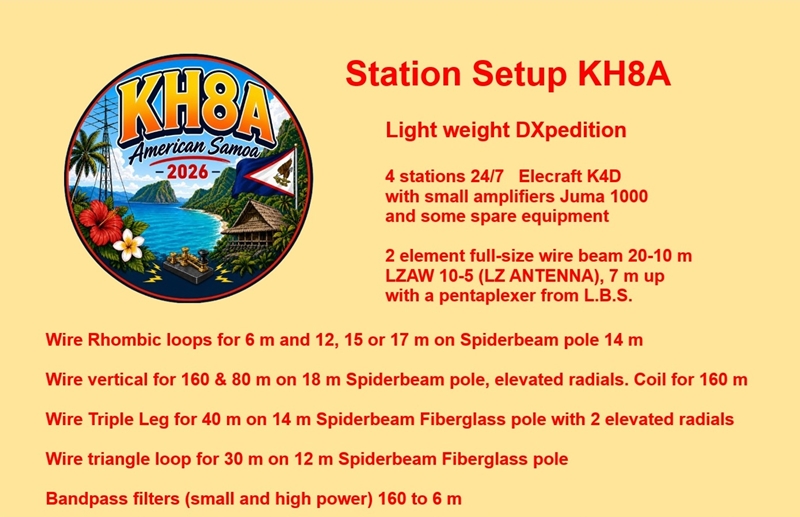
Four stations with amplifiers (400…800 W) will be QRV 24/7, offering a balanced mix of CW, SSB, FT8 and RTTY from 160 to 6 meters. We will utilize a full-size, two-element wire beam with a pentaplexer for 20 to 10 meters. For other bands we will deploy precisely tuned single-band antennas.
Due to the airline’s flight schedule changes from KH6 to KH8, we now have to spend three unplanned days in Honolulu instead of just one. Nevertheless, we are still highly confident, that we will reach our target of 70.000 QSOs.
We plan to upload daily online log updates to Club Log and, if conditions allow, provide a livestream. QSLs and LoTW will be handled as usual via OQRS on Club Log or through our manager DL4SVA. Paper QSLs are expected to be printed until Christmas.
We’re fully prepared! With pretty much the same experienced team and gear, we’re as confident in our skills as ever. The global support from all the DX clubs and individual operators out there is invaluable — it’s a massive boost for us to give it our absolute best. A huge thank you to everyone supporting us.
Hear you all from American Samoa — may the sunspots be with us!
News #2 (July 13, 2026)
We are pleasantly surprised that, in early July, propagation conditions briefly reached an SFI of 200 again — as they did at the peak of the 25th solar cycle—though with an increased risk of interference and dropouts.
A VOACAP propagation forecast by OH6BG is integrated into our website. We are eager to see what propagation conditions await us on the low and high bands. The major ham radio regions of Japan and the U.S. are at least 8,000 km away, and Europe is as far as 15,000 km away.
Unfortunately, Alaska Airlines changed its flight schedule for October on June 30. The flights had already been booked in March/April. We’ll fly from Germany via Canada or the U.S. to Hawaii and then continue on from there. We’ll now be spending two fewer days in American Samoa, so we’ll be QRV from October 30 to November 12, 2026. This also means that we will spend two extra days in Honolulu. The organization of the KH8A DXpedition continues according to plan, and we are sticking to our commitments. Four stations equipped with small Juma power amplifiers will be on the air around the clock from 160 to 6 meters in the main modes. Some equipment has already been shipped to the individual team members, who live in various locations throughout Germany. As a well-organized lightweight expedition, each operator will carry approximately 30 kg, including personal luggage, on the flight. Two long ski bags containing the antenna equipment will be transported separately for an additional fee. The team would like to thank sponsors, foundations, and individual stations for the support they have provided or pledged so far. These are listed on our website.
News #1 (May 5, 2026)
After T2C, C21MM, V6D and other DXpeditions our team is ready for the next adventure.
This time we’re heading to American Samoa (KH8) in the South Pacific. KH8 main island is mountainous, which makes things challenging. That's the same QTH from which KH8T was already on the air two years ago. Our call is KH8A.
The organization including several visas was not easy. Now all flights and the QTH are secured.
Of course, we’re aware that conditions on the high shortwave bands are deteriorating and that the focus is shifting more toward the mid and low bands.
The team includes nine operators DJ9KH, DK5WL, DL1KWK, DL2RNS, DL4SVA, DL6KAC, DL6KVA, DL7JOM and DL7VEE. We are planning to operate 4 stations 24/7 from 160 m to 6 m in CW, SSB, FT8 and RTTY.
We use carefully tested, high-quality equipment, based on the experience gained from our previous expeditions. On the high bands, we will use our reliable full-size 5-band 2-element wire antenna from LZ-Antenna in combination with a pentaplexer, allowing us to operate on multiple high bands simultaneously with this antenna. On the other bands, we use well-tuned single-band wire antennas. The fiberglass poles and the HD aluminium telescopic mast for the beam are manufactured by Spiderbeam company. The transceivers are high-end K4 models from Elecraft. All equipment, most of which is privately owned, including small amplifiers from various manufacturers, will remain with us during the flights to prevent damage during transport.
